The name Isaiah Mitchell is synonymous with the phrase “guitar god”. Nobody will deny that. Mitchell has been the guitarist, and on occasion vocalist of the psychedelic/cosmic trio band Earthless for 25 years. Along with Isaiah Mitchell, the band includes the thunderous rhythm section of Mike Eginton(bass) and Mario Rubalcaba, and these three West Coast musicians have built a career out of monolithic jams inspired by everything from Hendrix to Krautrock to 70s jazz fusion to Sabbath and atmospheric interludes. Albums like Rhythms from a Cosmic Sky, Sonic Prayer, From the Ages, and their latest Night Parade of One Hundred Demons display both a knack for head spinning psych jams and also thoughtful, underscored musical meditations.
Earthless just aren’t a guitar band, and Isaiah Mitchell isn’t just a guitarist.
Which brings us to Isaiah Mitchell’s debut solo album titled Beyond. Now if you’re going in thinking it’s gonna be more expertly crafted solos and big riffing you might be surprised. In fact, I guarantee you will be as Beyond shows a whole new creative side to Mitchell. It’s composed, arranged and performed by Isaiah Mitchell almost exclusively on synthesizers. It’s a heady, contemplative, and existential sound journey inspired by the giants of 70s German synth pioneers like Michael Rother, Manuel Göttsching, Ash Ra Tempel and Brian Eno; as well as growing up around synths, sequencers, and drum machines.
There’s plenty of shimmering guitar that accents his excellent compositions, it’s just not taking centerstage. But I’ll just stop and let Isaiah tell you all about his stunning debut.
J Hubner: So let’s talk about your brand new solo debut album ‘Beyond’ with PFR Records. Listening to lead single “Memory Forgiveness” really floored me. Not only as it’s a beautifully long drift of heady electronic music, but that it’s such a departure from what has come before with Earthless and other projects.
What was the impetus of this project? And how long have you been working on it?
Isaiah Mitchell: Thank you for the kind words!! I’m glad you’re enjoying the first single! I have been messing around with synth based music for a couple years now and have started to compose songs primarily with synthesizers and I’ve been feeling very comfortable in this place. Sometimes way more comfortable than I am with guitar. So it started as an outlet to get the music out of myself that required synths. I would say that I have been working seriously on a record for about a year now, but I rewrote the album that is BEYOND starting around April this year.

J Hubner: How long have you been working with synths and electronic music in general?
Isaiah Mitchell: I’ve been fiddling with synthesizers since a teenager. My dad had some, and a lot of friends seemed to have different synthesizers growing up. There was a time when the Juno 60 was totally undesirable and no one gave it too much attention which is crazy to think about, but we grew up with that synthesizer around. There’s a few Earthless recordings that I put synthesizers on. I believe Mini Moog and a Juno 60, so they’ve been around me here and there. But I would say in the last three maybe four years I started purchasing synthesizers and diving deeper into them just for myself. I found that they contain sounds that are really desirable and attractive to me and I can’t get that sound with a guitar necessarily.
J Hubner: I love the description of this album being “Inspired by the mere fact that we exist, it meditates on the origin of consciousness, the experiences of being human, and the wonderment of what lies beyond death, with a focus on tapping into the present moment and discovering the peace, harmony, and oneness of all existence.”
Was there something in your life that inspired you to tackle such a heady, existential topic when it came to sitting down and composing for ‘Beyond’? I listen to electronic music for its meditative state it can bring on, and so far “Memory Forgiveness” is totally giving me those vibes.
Isaiah Mitchell: I got deep into Tibetan Buddhism as a late teenager and got into meditation and yoga deeply around that time as well. I spent about 20 years of my life on a completely different path and it was a mostly self-destructive one in my 20s and 30s. But I cleaned up and when I did, I started to feel the call again to get reacquainted with meditation and Tibetan Buddhism and getting back into yoga. Once this happened, I really started to feel the impermanence of everything in existence -including myself- and it became a very important subject of my focus ever since.
To me, it is important to live with that awareness side-by-side to everything that happens in life. I don’t want to forget that reality so it stays close to me and it is very inspiring. I know there’s a lot of things to write about and express but for me right now the fact that I’m getting reacquainted with this reality is what’s in the forefront for me right now. It’s been very helpful to have my wife also be very much on the same page with the subject. We have both inspired each other creatively to look at that and interpret it into an art form.

J Hubner: Tangerine Dream, Klaus Schulze, Vangelis are a few names that come to mind when it comes to the headier side of synth-based electronic music. There’s also a resurgence of ambient music with labels like Azure Vista Records, Past Inside The Present, SFI Recordings and zake drone recordings.
Who are some artists or records that are in the DNA of ‘Beyond’ for you?
Isaiah Mitchell: The German musical movement of the 60s and 70s has had one of the most tremendous impacts on me creatively. As much as the delta and electric blues. And Jimi Hendrix. In particular, Michael Rother and Manuel Göttsching. The Ashra album New Age of Earth is one of the most incredible electronic ambient albums ever created in my opinion. So definitely Manuel Göttsching is a huge point for inspiration. The first time I heard Brian Eno’s Apollo album that changed the game for me big-time just understanding atmosphere and space. That album is very important in what it has done to me since the first time I heard it. Also, the Brian Eno album with Laraaji had a big impact growing up.
I remember being a teenagers going through my father’s record collection pulling that record out and going to bed listening to that album. Also, the first time I heard Daniel Lanois’s album Belladonna that completely opened me up to new possibilities and new ways of thinking. Growing up I would see the amazing 2 piece Zombi live and they blew me away. I love all of Steve Moore’s albums since. Very inspirational growing up seeing this kind of music live. And I know it’s guitar, but hearing Neil Young’s score of Deadman was heavily influential with his use of atmosphere and super ambient reverb.
I would say those artists are the ones that kick started the fascination and desire to create that kind of music and create those kinds of sounds. And from there, countless other sources of inspiration from artists like Patricia Wolf and Popol Vuh, but those are the first stones on the path.
J Hubner: Has heavy synth/ambient music played a part in your listening diet for a long time?
Isaiah Mitchell: Yes, definitely it has been. I think starting as a kid listening to Van Halen. Just that sonic texture that the synthesizer has in that heavy guitar music I always thought it was incredible. And my dad composed almost all of his music with sequencers, synthesizers and drum machine so I got to watch somebody create music using all electronic instruments and I thought that was very cool to be around as a kid.
Hearing Mahavishnu Orchestra for the first time as a teenager and listening to Jan Hammer was life-changing because the way he plays, the way he phrases and the tones that he got and the sounds that he chose were very influential and like futuristic sounding in a world of rock ‘n’ roll. That was a big piece of the puzzle. Definitely synthesizer came to me first in a rock ‘n’ roll format, but as I grew up -especially once I discovered Brian Eno and seeing this whole other side of musical expression that was much more gentle and meditative and exploratory- it got me very curious to what else is out there.
J Hubner: Do you think this resurgence in ambient music is a result of us humans at large needing some quiet, contemplative place to escape to?
Isaiah Mitchell: I think so. That’s definitely one reason absolutely. I personally don’t listen to heavy music. I know I play pretty heavy music with Earthless but if you were to look at my playlist on any platform or my listening history, you’re gonna see a lot more mellower stuff and a lot of it is heavily synth-based. I think the frequencies feel good and they’re good for the brain especially playing in an intentional therapeutic way.
I know some people listen to only heavy music all the time. I think in some cases it’s a phase because people do seem to get out of that and wanna listen to something completely different than what they’re associated with. For me listening to New Age of Earth after a show on tour driving to the hotel or listening to a live Townes Van Zandt record where he’s just playing acoustic guitar and singing is a way better vibe in those environments.
J Hubner: How did you get connected with PFR Records? Seems like a perfect fit for the sonic world you’re building here.
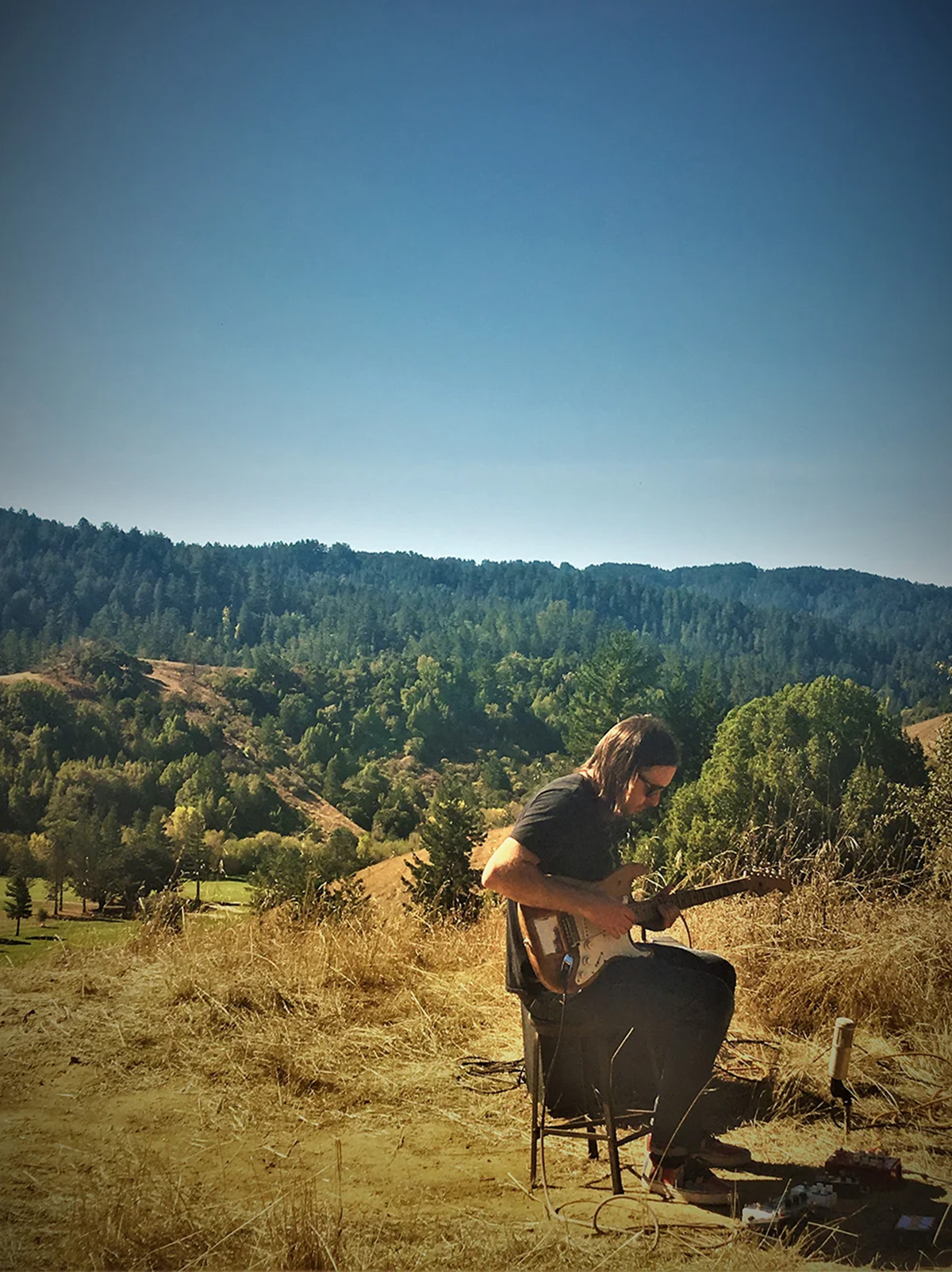
Isaiah Mitchell: TJ(PFR Label Manager) had seen Earthless play, he was saying, and we talked and he explained the label that he has which is PFR RECORDS, and I told him yeah I’ve been dabbling in more electronic ambient music for myself. And he gave me an opportunity to present some music to him and to release it out in the world. I’m very grateful I met TJ because this is the first record I’ve created on my own and have released out into the world.
I’ve always done things with bands and collaborations. I have a lot of self-doubt and insecurities, but I am getting a lot better with that and this record is a huge statement just for myself to myself that I am capable of doing something like releasing a record on my own and it actually having some weight to it and that people will actually connect with it. Those 20 years of hiding and avoiding weren’t the kindest for me towards myself, but I’ve started to wake up and things are changing. So very grateful for TJ and PFR RECORDS for the opportunity to get my expression out.
J Hubner: Do you plan on playing some live shows to help promote ‘Beyond’?
Isaiah Mitchell: I do. There’s some stuff in the works as we speak. I would really like to keep creating and getting out there and learn how to do all of this live.

J Hubner: Besides ‘Beyond’, you are also on a collaborative album with the guys in Danish band Causa Sui called ‘Terramar’. How did that collaboration come about?
Earthless had a tour in Europe and about 10 days later I had a show booked with some friends in Australia at a festival in Germany so I did not want to fly back to California and then fly back for the jet lag factor, and for spending more money on flights during the summertime. So my wife helped me brainstorm some ideas for being productive and staying in Europe. And she said why don’t you reach out to Causa Sui? So I did and they were all available and way down to get together.
We didn’t know what to expect. We didn’t know what was gonna happen. I’ve met those guys a few times in the past. We’ve played some festivals together and we all got on well, but I didn’t really know them and we’ve never played together to know what it was gonna be like, but I think we all had a good idea. It was gonna be pretty fun.
So I went to Odense where Jonas the guitar player lives and where their studio is and the other guys took some time off from work and we spent about three full days in the studio together and we recorded everything and then Jonas and I did overdubs and we also did just some different stuff, the two of us, and it was very fruitful and we were all very happy with the results.
J Hubner: What was the overall experience like for you?
Isaiah Mitchell: It was a very inspiring handful of days. And now we’ll share the sessions with everyone who wants to hear it. Everything was done spontaneously no pre-thought out riffs or ideas. We all just played whatever came up. Everyone would take turns starting and then we’d go from there and we ended up having hours and hours of music that is all usable surprisingly enough. There’s way more usable music than there’s unusable, which for an improvisational setting isn’t always the case. It can be pretty flat and dead and uninspired sounding but we were all in the right space and in the right frame of mind. I’m very happy about the result and the time spent with those guys
J Hubner: I love the duality of an artist. Artists like Paul Riedl who’s main gig is in the cosmic death metal band Blood Incantation that puts out amazing ambient/new age records on his own. Or Joel Grind from Toxic Holocaust is equally into both extreme metal and Berlin School synth. Even your bandmate in Golden Void Justin Pinkerton put out an amazing Komische record with El Paraiso Records back in 2020.
What is the pull from guitar-heavy music to the world of synth-heavy ambient vibes? It almost feels like a type of music therapy for the artist as much as it is the listener. I’ve come across this a lot over the years and I think it’s great that an artist can express themselves through such differing sonic journeys.
Isaiah Mitchell: It’s just another area to explore. If you have a creative person, they’re gonna gravitate towards all kinds of different outlets and different tools to express what’s inside of them. I think for everyone that you mentioned here, synthesizers offer so much and electronic instruments offer so much in ways that a guitar or a trap kit can’t always succeed in. They’re different instruments so they’re gonna make you play differently. And the great thing about a synthesizer is right away you can make it sound just fantastic whereas guitars or drums there’s a lot of skill that goes into that.
The beautiful thing about synthesizers and drum machines is that anyone can get going on them. The learning curve isn’t crazy and you can make really beautiful sounds instantly once you know what you’re doing, especially. And for me, I am a lot more musically than just my guitar. My guitar is very dear to me and has been my best friend and expression since I was a teenager and it always will be, but there are things that can’t be expressed with a guitar in the way that a synthesizer can.
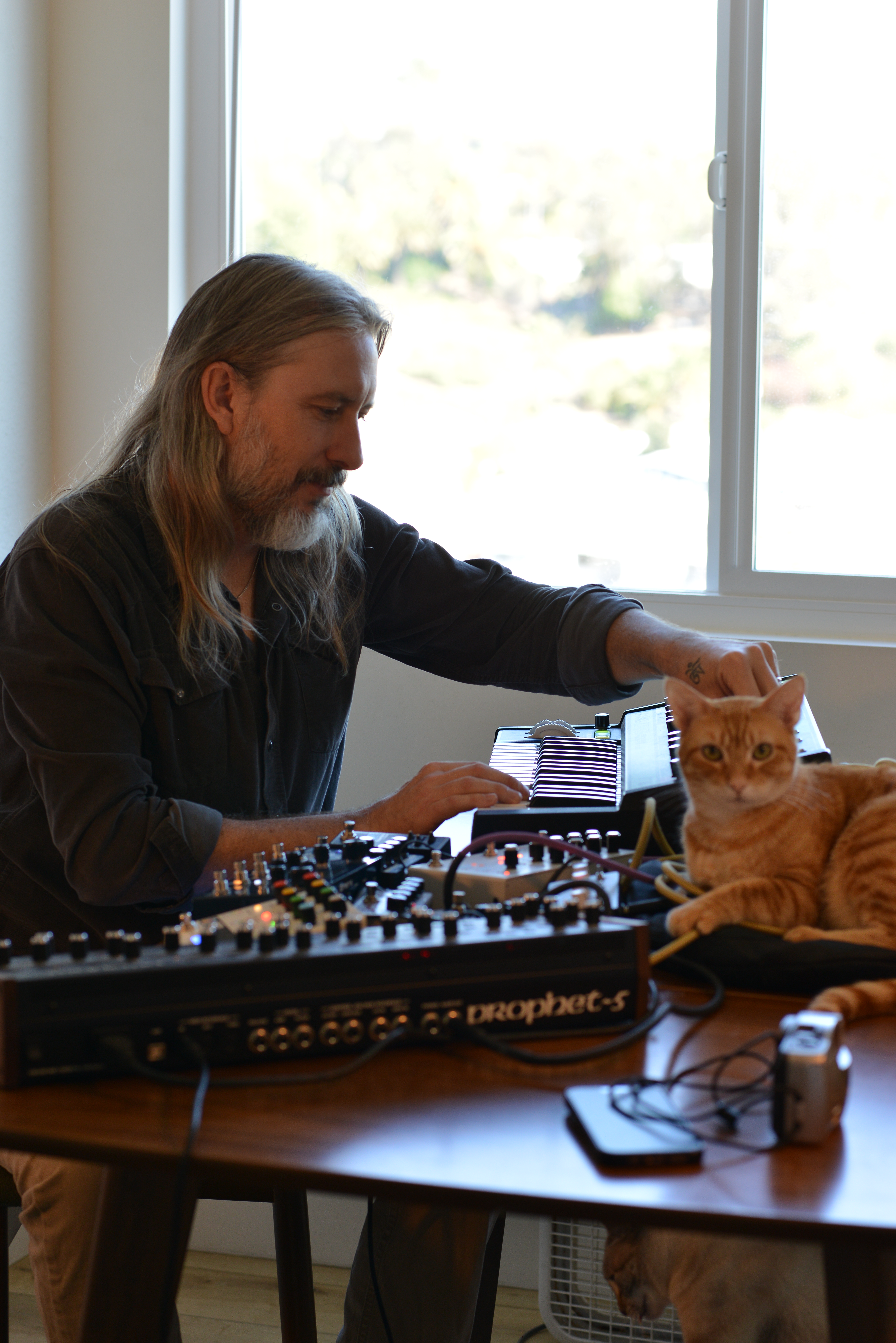
For this record I ended up getting a Prophet 5 and right away the emotional response my body had by listening to the texture and the frequencies that the Prophet 5 possess….it was intense. Tears came due to the joy of feeling these sounds. And in discovering this synth I was feeling that this is exactly the sound I’ve been looking for and have been dreaming of; it is everything I could ever want in an instrument.
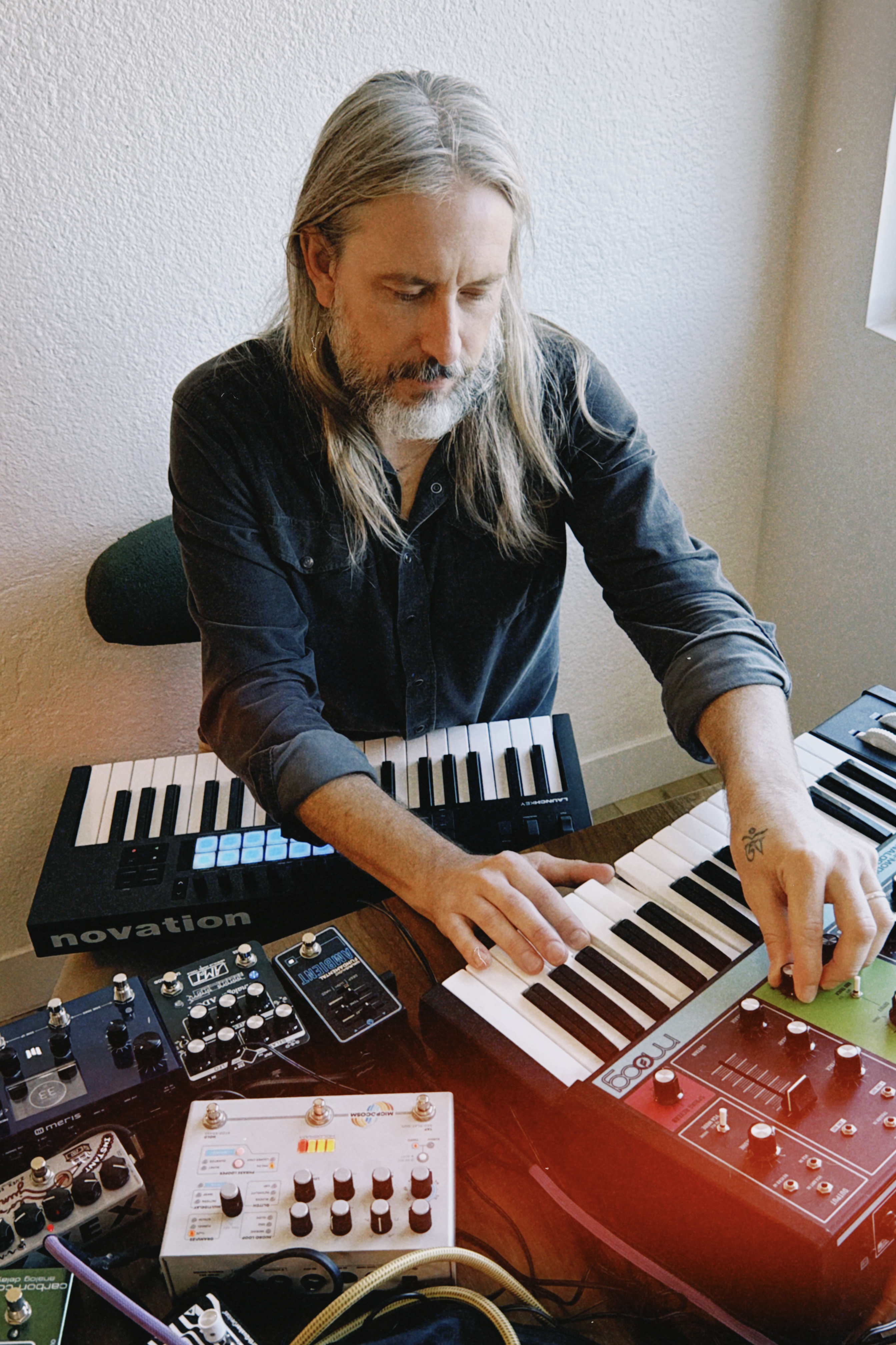
It is very rare to get that kind of a response from instruments for me. I’ve had that same experience with some guitars and some amplifiers and some guitar pedals, but the Prophet 5 hit me on a very high level. It felt spiritual in the moment of discovery. It gave me the opportunity now to truly express the feelings and emotions that I wanted to express in making this record. And that’s the beautiful thing about synthesizers to me.
It’s a whole other world of painting, and for me right now it’s the only world I know of that serves that particular expression.
‘Beyond’ is out now via PFR Records. Buy it here.
Discover more from Complex Distractions
Subscribe to get the latest posts sent to your email.

