Danish artist Jonas Munk wears many hats. Besides being guitarist/producer in Causa Sui, Munk releases solo records, as well as the collaborative project Billow Observatory with Auburn Lull’s Jason Kolb. He’s also a producer, mixer, engineer for other artists as well, most notably Nicklas Sorensen of band Papir. Munk also runs Azure Vista Records and co-runs El Paraiso Records. Like I said, many hats.
But years before all of that Jonas Munk had an electronic music project called Manual. Inspired by late-90s electronica, Munk set out to make electronica with more song structure and melody and did just that. Everything from shoegaze to dream pop to even ambient records, Manual and Munk showed what you can do with electronic and IDM music, by adding pop-oriented song structure to the electronic world.
It’s been 16 years since the last Manual release, and 25 years since the debut record. Jonas Munk has pulled the moniker out of retirement and has given is the excellent True Bypass, a return to form album that feels like picking up where he left off. Jonas sat down to answer a few questions about the new album, its origins, and all things Manual.
J Hubner : It’s been 16 years since the last Manual record. In that 16 years you’ve released several albums with Causa Sui, started collaborations such as Billow Observatory with Auburn Lull’s Jason Kolb, have collaborated with Ulrich Schnauss as well as Brian Ellis in the The Ellis Munk Ensemble, made records with Papir’s Nicklas Sorensen, and a steady flow of amazing
solo works. You also started Azure Vista Records.
What was the impetus to returning to the world of Manual?
Jonas Munk : For the past few years I’ve been heavily drawn to this kind of music again – I dusted off my 1990s Aphex Twin CDs as well as a lot of the more or less forgotten electronica and post-rock from around the change of the millennium. There’s so much good stuff from that era, especially all the albums released on smaller labels in Berlin and the UK, and I really fell back in love with that sound. I was really into this stuff in the early 2000’s, but pretty soon the market became flooded with glitchy, melodic electronica (even mainstream rockers such as Radiohead began to incorporate it into their sound, although in a watered down way) so after a while I naturally gravitated towards other types of music. But now, two and half decades later, the times have changed so much and everyone seems to have forgotten about all this stuff long ago, so to me there’s something so alluring about that sound again – producing True Bypass felt a little like exploring a ghost town.
The two electronica-oriented Billow Observatory EPs Soliton and Calque from a few years back also whet my appetite for producing IDM-beats and working with detailed midi programming again. And when I came out of a pretty intense Causa Sui production streak – following From The Source, In Flux as well as a live LP – it really felt like the perfect time to work on something completely contrary to that and revive the Manual project.
J Hubner : For those coming to Manual for the first time with the new record True Bypass, can you describe the inspiration for Manual’s sonic world and what you were wanting to accomplish at the beginning?
Jonas Munk : Back in the late 1990s I got really obsessed with a pretty wide range of music that was combined under the term “electronica” – a kind of brainy and artsy electronic music that often incorporated minimalist, melancholic melodies – as well experimental post-rock such as Tortoise, Aerial M and To Rococo Rot. A lot of the new electronic music was super interesting sound-wise, but I often felt it lacked the interesting song structures I was used to in the rock music I grew up with. Song structure is an aspect of music that has always intrigued me, but a lot of the electronica was overly simplistic in structure and often just based on loops and
endless repetition. I felt I could create a slightly different sort of electronica that took cues from rock music and incorporated instruments such as guitars, as well as more intricate song structures.
My first album, Until Tomorrow, was released on Berlin label Morr Music exactly 25 years ago, and actually did quite well. The production is kinda lo-fi and rough; it was all done with a few analog synths, an Akai sampler, some guitar pedals, a Yamaha midi sequencer and recorded on a digital 8-track Fostex recorder (mostly in mono to save tracks). But I think it’s actually still an interesting listen. It’s kinda awkward sounding a lot of the time, but there are plenty of nice chord progressions and strong melodies that still resonate with me today. From the perspective I have now I think it’s a decent contribution to the electronica of the time. Some parts really work surprisingly well when listening today – the production is just super awkward.
J Hubner : Let’s talk about the new record. What was the gestation process for True Bypass? How long have you been working on it? Was the creative and writing process similar to how you approached Manual records in the past?
Jonas Munk : True Bypass took me a full year to produce – a whole lot longer than I would spend on a record in the early days. I’ve become a lot more patient throughout the years, and if something doesn’t feel 100% right I’m gonna redo it or scrap it. 25 years ago I cut a lot of corners(probably a good thing, I was a weird enough teenager), and I’d often include stuff I knew deep down could have been a lot better in every way. It took me several years of producing music until I developed enough honest self-criticism and patience to make really good productions. I think for me – and this is probaly also true for a lot of other people – there was bit of a Dunning-Kruger effect at work: I really overestimated my own abilities, and it wasn’t
until several years later I realized how little I actually knew, and how much time and effort I really had to put into my work. But the good thing about being young and overly confident is that it really motivates you to get stuff done – had I known how far there was to go, I’d probably have spent my time on something else entirely…
So by now I have a much more realistic approach. And over the years of producing a lot of different music I’ve kind of figured out a lot of the things that were mysteries to me back in the early days – both when it comes to sound design and mixing, but also in regard to what makes compositions work. Looking back on the first run of Manual albums 2001-2010 it’s evident I made some really strange decisions here and there – like, why would I let a certain melody run for two minutes when thirty seconds was enough?!?? -and stuff like that. When producing True Bypass I genuinely felt I had a much clearer perspective on certain things, although the approach to writing and production basically wasn’t too different than it was the past.
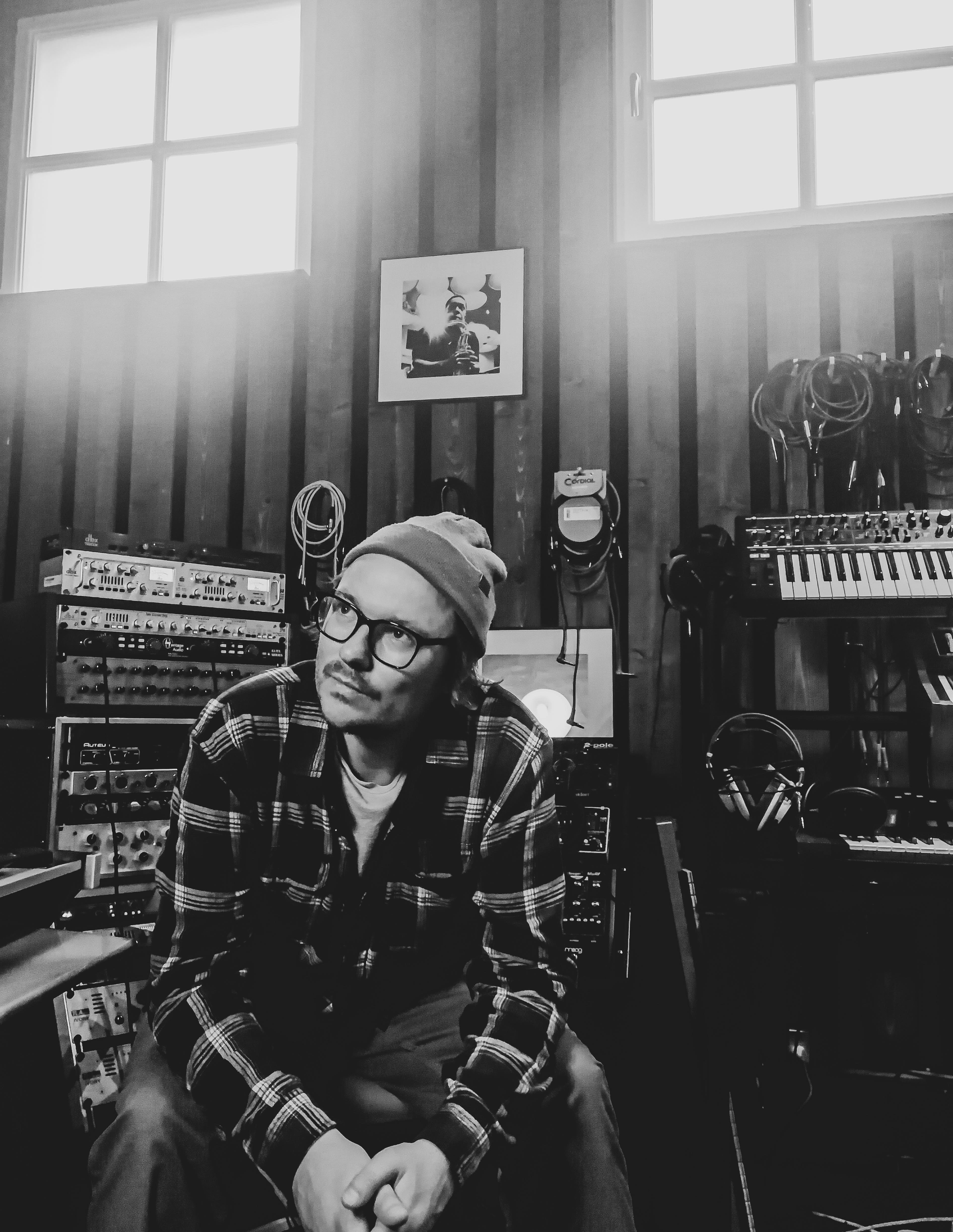
These days I also have a much nicer studio and lots of gear that I could only dream of back in the early days. Having an acoustically treated room and good monitors just make things a lot of easier. And although I had some nice synthesizers in the early days (some of which I still use to this day) I didn’t have good reverbs or microphones or anything. I also did all my beats on an Akai s2000 sampler, which was so clunky to operate compared to later software samplers that you could integrate to your DAW. Like, mapping sounds and tweaking parameters really took some time back then. And it didn’t have internal memory so you had to save your patches to floppy discs! It sounded great, though. Also, in the early 2000’s I would have absolutely loved to be able to use current gadgets such as the Empress Echosystem or the Hologram Microcosm which I’m using a lot these days.
J Hubner : Gear-wise, what are the tools you use when approaching the world of Manual. Is it similar to an album like Minimum Resistance?
Jonas Munk : The main difference is that those ambient albums are built with more minimal instrumentation, it isn’t as layered, whereas when I do the Manual stuff with beats and programmed sequences I spend a lot of time on building instruments in Kontakt (a software sampler I use a lot) and programming midi sequences – something that demands a lot of time and focus. I’ve always mainly used hardware synths, and the Korg Minilogue, Roland Juno 60 and Yamaha SK-20 are all featured heavily on True Bypass.
J Hubner : Going back through the discography of Manual recently, there was an evolution of sound throughout. You had the more rhythmic, dream pop approach of albums like Drowned In Light and Azure Vista. But then you put out the dense and ambient-driven Confluence.
Jonas Munk : Yeah, the early albums on Morr Music were all very rhythmic and IDM influenced, but later the Manual sound split into two directions: albums such as Drowned in Light, which were more dream-pop influenced, and the pure ambient albums such as The North Shore and Confluence. Looking back it really would have made sense to use a different artist name for the ambient albums, but back then I didn’t know there would be more than one! I was invited to do an entry for Darla’s “Bliss Out” series (a lovely series of ambient albums that ran for several years) and I did an ambient collab with my friend Jess Kahr for it, called The North Shore. Back then I never imagined ambient music was something I’d spend a large chunk of
the following 20 years on! I really thought there’d only be that one.
J Hubner : Where do you see True Bypass sitting amongst the discography?
Jonas Munk : I see it as a return to the style of the earliest Manual releases – Until Tomorrow, Ascend and Isares. But I guess there’s probably ingredients from the later albums in there as well. The last Manual release in the first run of albums, the six track EP Awash released in 2012, is also my favorite of the whole bunch, and I can hear some ideas from that in True Bypass too.
J Hubner : Speaking of Confluence, Darla Records recently reissued it as a 2LP for the first time. How did that come about? Btw, I’ve been spinning that on constant rotation.
Jonas Munk : Confluence was the third and last Manual ambient album. When it came out in 2007 it didn’t generate much attention, but over the years it has become pretty well respected among ambient afficionados, and surprisingly it has become the most streamed Manual album on streaming services over the years. Back in 2007 releasing an ambient album on vinyl didn’t make much sense (it wouldn’t sell), but the odds are better these days. We’ll see! Darla did a great job on the reissue and I’m really glad it’s finally available on vinyl.
J Hubner : What does the rest of 2026 look like for Jonas Munk? Can we expect some releases from El Paraiso Records? Do you have any other projects lined up that we can look forward to?
Jonas Munk : Yes, there’s a few El Paraiso releases getting ready for production at the moment. And I’m also working on more Manual music these days.
Manual’s True Bypass is available now via Darla Records. Buy it here.
Discover more from Complex Distractions
Subscribe to get the latest posts sent to your email.

