I don’t think I will ever come to the day where Miles Davis doesn’t fascinate me. Even if I didn’t connect musically, the guy is a mystery wrapped inside an enigma. His phases so completely defined as an artist that there’s literally lines separating them; chapters in a book as dense as Pynchon, but taken individually on their own can be unlocked with deep listening and dedication.
I remember buying myself Bitches Brew for my 37th birthday. Prior to that I think I’d bought one other Miles record, Nefertiti. With Nefertiti he was still working with his second great quintet(Herbie Hancock on piano, Ron Carter on bass, Tony Williams on drums, and Wayne Shorter on saxophone) and they’d sharpened their sound to a distinct sharp edge. Heady compositions(courtesy of Shorter and Hancock) that felt both intellectual and dangerous at the same time. Abstract songs that felt alien yet connected in a visceral way to the world that was happening all around them.
Bitches Brew saw that quintet disintegrate, while Miles built the perfect beast that would become the band that would record the monumental In A Silent Way and Bitches Brew. It was a small army of the best of the best in the world of jazz that would go on to define 70s jazz fusion. And after Bitches Brew Miles would go on to make some of the wildest and far out records of the decade. One of big components of Davis’ 70s output were live records. Live Evil, Dark Magus, Live At The Fillmore, Pangea, Agharta, Black Beauty; as well as conceptual and ambient meditations like On The Corner, Get Up with it, Big Fun, and Jack Johnson.
The Miles era from 1969 to 1976, for me, is the most essential. Of course the cool jazz phase and post-bop are equally important. He defined an era and a vibe between the late 50s and early 60s, but for me it was only when he disassembled what he’d built previously and put it back together in this strange, new musical world is when he really shined. It’s one thing to define a musical genre and build it from the ground up. But to take a sure thing and let it fall only to rebuild it in such a singular, mysterious, and yes even dangerous sound is when you go from a king to a legend.
He took tradition and set it on fire. He took restraint and traded it for chaos. Suits and ties were replaced with a taste of the counterculture. He was more interested in what Hendrix was doing, as opposed to what Charlie Parker did 20 years before. And the traditional jazz sound was corrupted and turned inside out, sounding more meditative, dark, and street-wise. Jazz was getting a much-needed facelift and rewiring for the times.
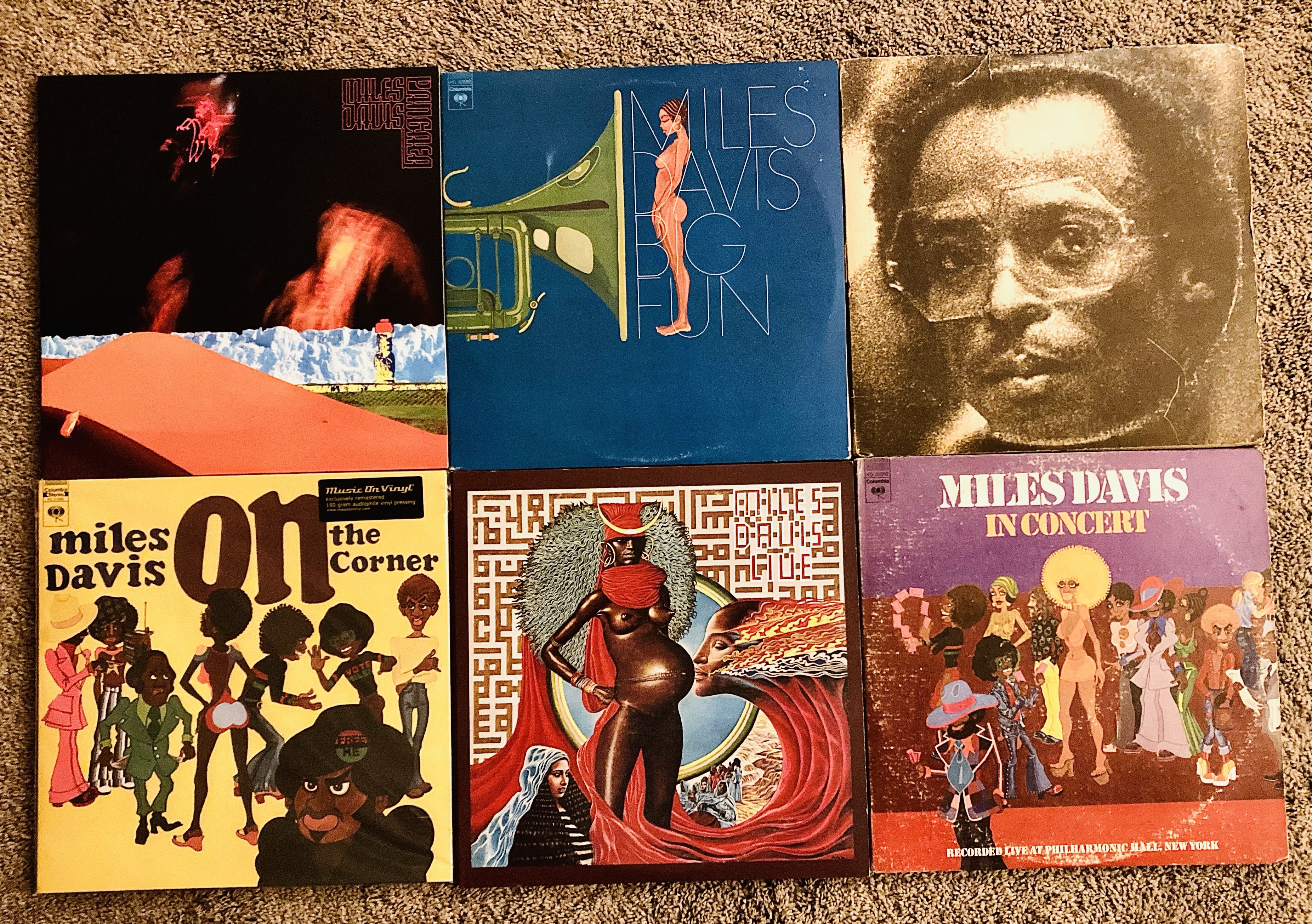
The word that comes to mind when thinking of albums like Get Up with it, Agharta, Pangea, and On The Corner is exploratory. The long improvisations and quiet interludes elicit the feeling of space and the cosmic. Listening to these albums I feel like Davis was delving into post-rock and progressive music before either was defined or even heard of. It’s not music to spotlight soloists or composition. It’s all about a feeling and riding that feeling for as long as you can. Miles Davis was obviously interested in the counterculture and the world of psychedelia; as well as the acid-burnt psych/pop worlds of Jimi Hendrix and Fly and the Family Stone. Funk and groove-oriented music was prevalent during these times and Miles was absorbing it all, wanting to make his own version of it.
Lately I’ve been listening to his live records, which even though they are live they were still treated, edited, and put together like his studio recordings. Producer Teo Macero took those live recordings and carefully cut and pasted to give each song the perfect sound and sequence. A lot of diehards didn’t like this manipulation of live recordings, but I disagree. Music is music, art is art, and to take these live recordings and turn them into something wholly unique, to my thinking, is a good thing. There was no overdubbing in the studio, it was just reimagining these tracks and giving them something unique. This cut and paste process was something Macero had been doing since Miles started recording the more long form works. I see that as a very good thing, and making the most out of the studio output. There is an art to cutting and pasting, and especially back then with real tape cutting with blades and splicing takes together to create a musical journey is something to behold.
Of that era I’ve been hitting Pangea and Get Up with it pretty regularly. There’s plenty of chaos going on, and long stretches of droning noise throughout which pull you out of your head and drop you into some ethereal frame of mind. It lasts till the side ends or someone in the house tells you to turn it off. Get Up with it is especially hitting hard. When you compare what was going on 10 years prior it’s as if you jumped from one timeline to another. Or you skipped into some alternate reality.
Whatever era of Miles is your thing, that’s a good thing. Because you’ve got Miles Davis in your ears. For me it’s those acid-fried, Electric Miles years. I think he went out as far as he could go, and maybe even went a little too far given his absence from the music world after 1977, till his return in 1981. Maybe he got too close to the sun and got pretty burnt because of it. Regardless, I think the man was a genius and what he did for both jazz and rock and roll is incalculable.
Discover more from Complex Distractions
Subscribe to get the latest posts sent to your email.

